Selected Work

Projects that demonstrate how we work and what we deliver.

Each case below reflects a real engagement — the challenge we were brought in to address, the approach we took, what we delivered and the outcome for the client. No summaries. No edited highlights. Straight account of the work.

Case Studies

Four engagements. Four different problem types.

Cloud migration project for UK financial services firm — OPSENSE AWS Terraform case study
Cloud Infrastructure

Full Cloud Migration for a UK Financial Services Firm

A mid-size financial services firm was running critical trading and reporting systems on ageing on-premise infrastructure. Hardware refresh cycles were expensive, disaster recovery processes were manual and untested, and the platform could not support the performance requirements of an expanding product line. Regulatory requirements for data residency and audit logging added further constraints on the migration approach.
We began with a three-week discovery phase, producing a full inventory of the existing systems, their dependencies and their compliance requirements. We designed a phased migration to AWS using a lift-refactor strategy — retaining core application logic while replacing infrastructure components with managed services. All environments were defined in Terraform from day one. Security controls were designed against FCA infrastructure guidance and ISO 27001 requirements throughout.
18-week delivery from discovery completion to production go-live. Parallel environments ran during the final four weeks of testing and validation. Go-live was executed during a planned maintenance window with zero unplanned downtime. Full observability stack — CloudWatch, Grafana dashboards and PagerDuty alerting — was live before the cutover.
Outcome
Zero downtime go-live. Infrastructure costs reduced by 34% in the first quarter. Recovery time objective reduced from 48 hours to under 4 hours. ISO 27001 certification achieved six months post-migration.

Healthcare systems integration — OPSENSE HL7 API enterprise data pipeline case study
Enterprise Integration

Systems Integration for a Healthcare Data Provider

A healthcare data provider working with NHS-adjacent organisations needed to integrate four separate clinical and administrative platforms — an EHR system, a scheduling platform, a reporting database and a third-party analytics service. Data was being exported manually between systems, creating accuracy problems and compliance exposure around data handling under NHS DSP Toolkit requirements.
We designed a hub-and-spoke integration architecture using an API gateway as the central integration layer. Each system connects to the gateway through a standardised connector — meaning future platform additions require only a new connector, not a redesign of the integration layer. All data flows were documented with explicit data classification, retention rules and access control requirements mapped to NHS DSPT standards. HL7 FHIR was adopted as the standard for clinical data exchange.
12-week delivery. All four integrations live on the new architecture. Manual data export processes eliminated. Full audit logging of all data movements implemented and mapped to NHS DSPT evidence requirements. A fifth platform was added by the client's own team six weeks after delivery — using the connector framework we documented.
Outcome
Manual data handling eliminated. NHS DSPT compliance maintained and strengthened. Client team self-sufficient on the integration platform within eight weeks of handover.
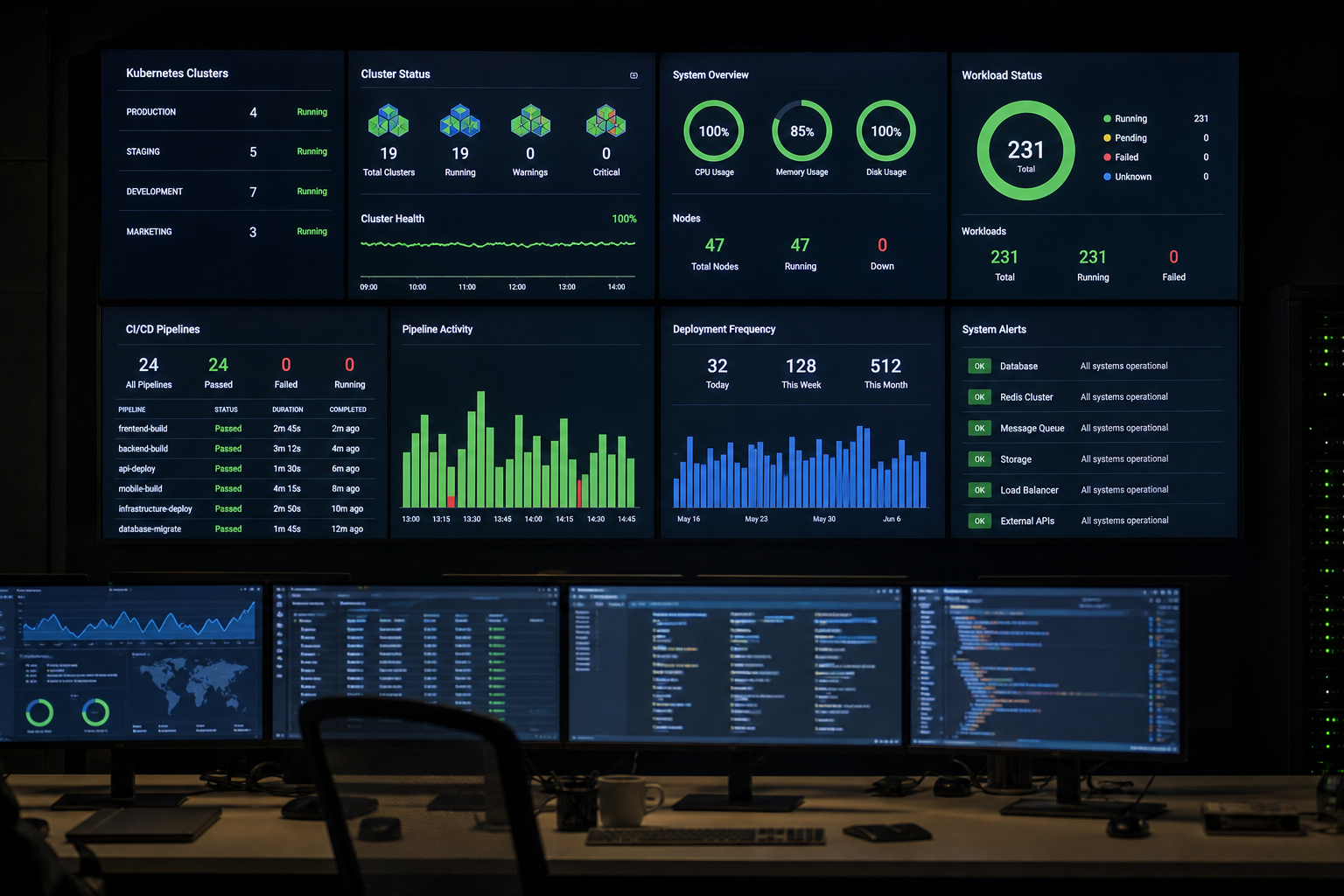
DevOps transformation for UK logistics group — OPSENSE Kubernetes GitLab CI pipeline case study
DevOps Transformation

DevOps Pipeline Rebuild for a National Logistics Group

A national logistics company with over 40 microservices had no consistent deployment process. Each service was deployed differently — some manually via SSH, some through ad hoc scripts, none with automated testing. Deployment failures were frequent and the mean time to recovery was measured in hours. The engineering team of 18 was spending an estimated 30% of their time on deployment-related issues rather than product development.
We audited all 40 services, categorised them by deployment complexity and defined a standardised pipeline template for each category. We introduced Kubernetes on EKS as the deployment target, replacing the mixed on-premise and ad hoc cloud approach. GitLab CI was configured with a common pipeline structure that all services could adopt with minimal configuration. We ran the migration in three tranches, starting with the lowest-risk services to validate the approach before applying it to business-critical systems.
16 weeks from audit completion to full pipeline migration across all 40 services. Kubernetes cluster configured with autoscaling, node group management and Prometheus/Grafana monitoring. Deployment frequency increased from approximately four times per week across all services to multiple times per day. Rollback procedures tested and documented for every service category.
Outcome
Deployment-related incidents reduced by 87%. Engineering time reclaimed from deployment management: estimated 22 engineer-hours per week. Deployment frequency increased 8x. MTTR reduced from over 2 hours to under 15 minutes.
Legal technology platform architecture — OPSENSE cloud infrastructure and systems design case study
Systems Architecture

Infrastructure Architecture for a Legal Technology Platform

A legal technology startup was scaling from 20 to 200 active clients and had reached the limits of its original single-server architecture. Response times were degrading under load, the system had no high-availability configuration and the founding engineering team had no previous experience managing cloud infrastructure at scale. The client needed a production-grade architecture that their team could operate — not a dependency on an external managed service.
We conducted a one-week discovery engagement focused on understanding the application architecture, data models and client usage patterns. We designed a multi-AZ AWS architecture using ECS Fargate for application workloads, RDS Multi-AZ for database, CloudFront for static asset delivery and WAF for application-layer security. All infrastructure was defined in Terraform with environment-specific variable sets. Security controls were mapped to Cyber Essentials Plus requirements and GDPR data handling obligations under UK law.
Ten-week delivery from design sign-off to production cutover. Architecture documentation and operational runbooks produced alongside the build. Three walkthrough sessions conducted with the client's engineering team before handover. Monitoring dashboards and alerting configured before go-live. The client's team managed the first production incident independently within the first month.
Outcome
Platform scaled to support 200+ concurrent clients without performance degradation. 99.95% availability achieved in the first three months post-launch. Cyber Essentials Plus certification obtained within four months of go-live. Client team fully self-sufficient on the platform within six weeks of handover.
Across All Engagements

Consistent delivery. Consistent standards.

200+
Systems Delivered
0
Unplanned Downtime Go-Lives
98%
Average Uptime SLA
100%
With Knowledge Transfer
Start a Project

Have a system that needs to be built — or fixed?

Tell us what the problem is. We will tell you whether we can solve it and what that would look like. Concise, honest assessment — not a long sales process.

Direct route to a senior engineer · Response within one business day

OPSENSE computer systems engineering — London UK delivery team